Frameworks for Relational Capacity, Solidarity & Liberatory Development
-
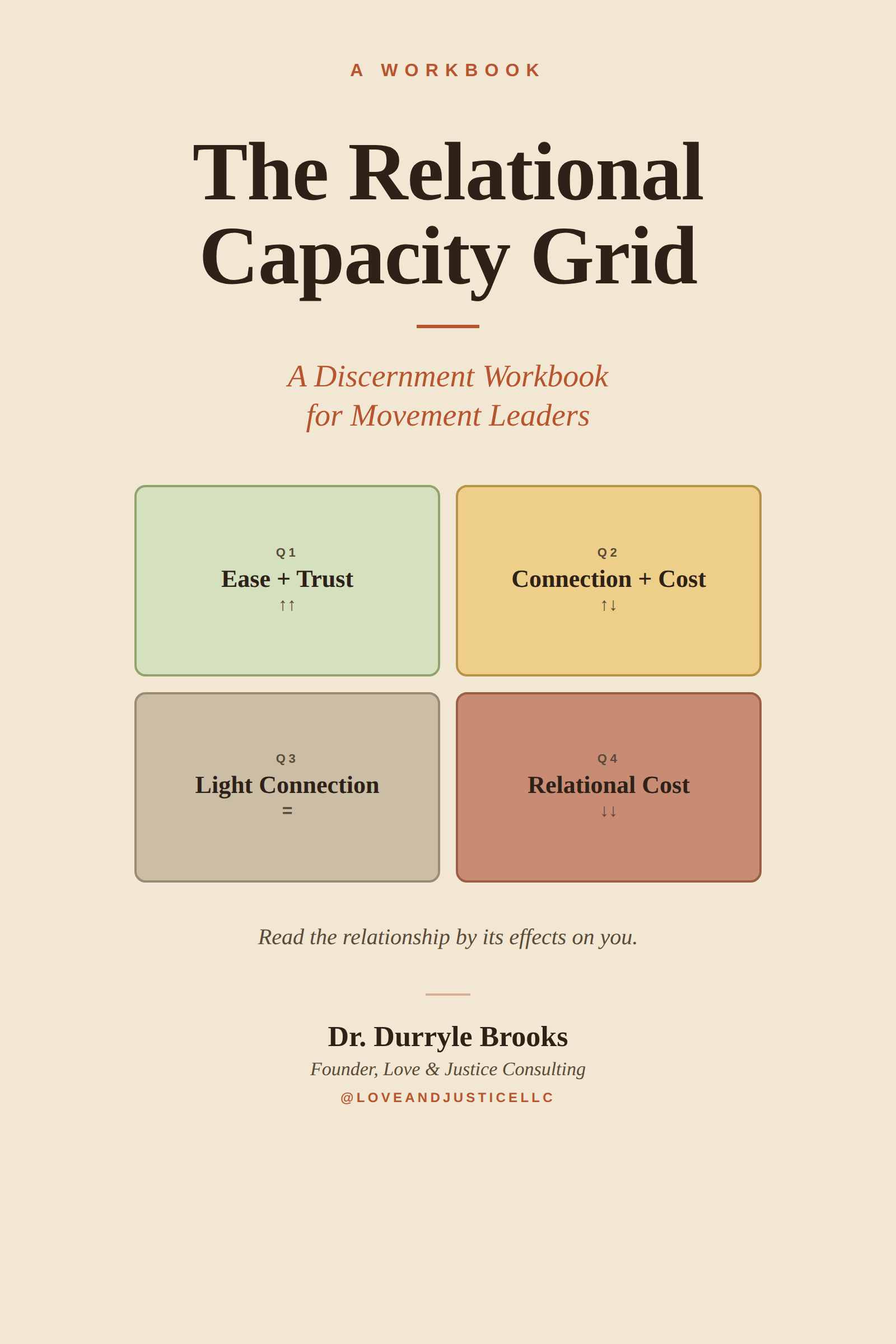
The Relational Capacity Grid: A Discernment Workbook for Movement Leaders
Your capacity is political. In movement work, every relationship costs something, and every yes is a claim on the energy liberation requires. Yet most of us were never taught to read our relationships honestly, or to protect the capacity our work depends on.
The Relational Capacity Grid is a 114-page discernment workbook that teaches you to read a relationship by its effects on you, its resonance, and its cost. Plot each relationship along the four honest quadrants of the Grid: Ease and Trust, Connection and Cost, Light Connection, and Relational Cost. What you find is not a verdict on the other person. It is information about where you are, what you can tend, and what needs to change.
Grounded in the Critical Theory of Love, this workbook is designed for movement leaders, organizers, and scholar-practitioners doing the long work of justice — a practice for staying whole while the work is still ahead.
Written by Dr. Durryle Brooks, PhD. 114 pages. All rights reserved.
-
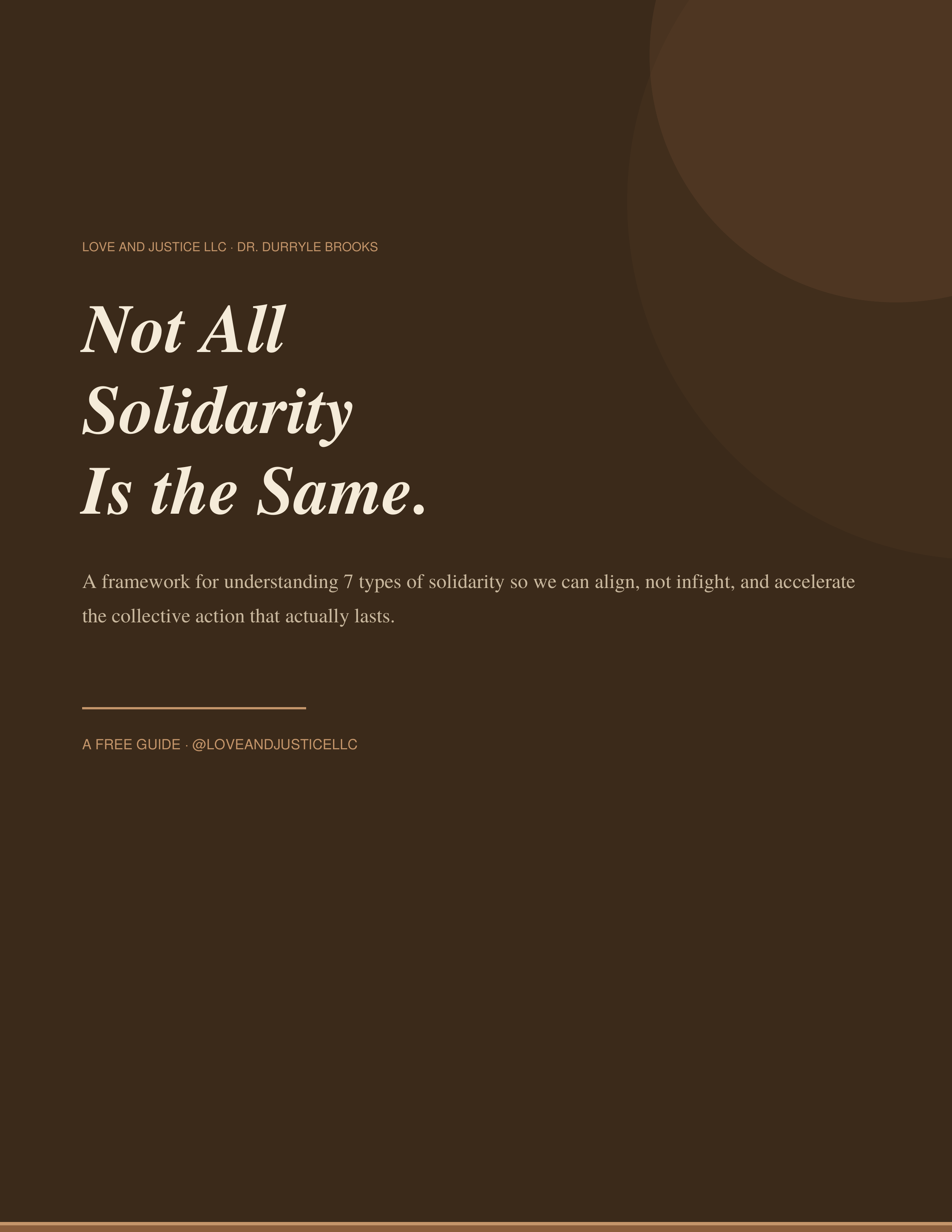
Not All Solidarity Is the Same: A Framework for Understanding 7 Types of Solidarity - Free Guide
We use the word solidarity constantly, in movements, classrooms, organizations, and online. But we rarely stop to ask what we actually mean by it. When people operate with different versions of the same word in their heads, they think they're aligned when they're actually talking past each other. Movements fracture. Coalitions collapse.
This free guide names seven types of solidarity along a spectrum from thin to thick: performative, conditional, transactional, digital, reciprocal, intersectional, and transformative. It's a tool for discernment: naming what kind of solidarity we're practicing, what it's costing us, and whether it's actually moving us toward liberation.
Grounded in scholarship on cross-racial solidarity, love as disciplined practice, and the Critical Theory of Love.
Written by Dr. Durryle Brooks, PhD. Free to share with attribution
-
Liberatory Developmental Framework — Free Guide
So many people are fighting each other without ever examining the underlying logics that shape the fight. Domination-based thinking doesn't just live in institutions, it lives in us. It shapes how we respond to conflict, how we assign worth, how we define safety, how we imagine what's possible. And when those logics go unnamed, they become wedge issues, fracturing people, separating movements, and keeping us from building the world we actually want.
The Liberatory Developmental Framework is a locating tool that maps eighteen domains of human life across three worlds: domination-based, transitional, and liberation-based. It helps individuals, communities, and institutions identify where they currently operate, name what they are moving away from, and imagine what they are building toward.
Grounded in the Critical Theory of Love, this framework is designed for personal reflection, organizational culture assessment, leadership development, conflict repair, and movement strategy — a shared language for orienting within complexity without collapsing into shame, fragmentation, or despair.
Written by Dr. Durryle Brooks, PhD. Free to share with attribution.