The Relational Capacity Grid©
a signature framework from Dr. Durryle Brooks
Your capacity is political.
Oppression steals our capacity and dysregulates us. Healing is not a nice to have — it is a necessity for movement sustainability. The Relational Capacity Grid is a framework for reading the relationships that shape your life so you can protect what your work requires.
Created by Dr. Durryle Brooks and grounded in more than a decade of scholarship on love, justice, healing, trauma-recovery, and liberation, the Relational Capacity Grid helps you name what your body already knows: that every relationship costs something, that some sustain you and some deplete you, and that your capacity is not infinite. Learning to read your relationships is one of the most political acts available to you.
The Pattern the Grid Interrupts
Many of us, especially those doing the long work of justice, care, and service, have been socialized to believe that abandoning ourselves is what commitment looks like. Skipping the meal to make it to the meeting. Believing if I don’t do it, then it won’t get done. Being on call for every emergency crisis. Pouring out when we are already empty. This is what I call virtuous self-abandonment: the martyrdom instinct wearing the language of solidarity, care, and love.
Movements and institutions reward this pattern. They call it dedication. But it is not sustainable, and it is not what liberation requires.
The Relational Capacity Grid interrupts this pattern by giving you a way to read your relationships honestly, name what is costing you, and choose your engagement with intention. It refuses the idea that depletion is a sign of movement and/or leadership commitment. It insists — quietly, structurally — that your capacity is worth protecting.
-
The Relational Capacity Grid©
Download the Grid- Free
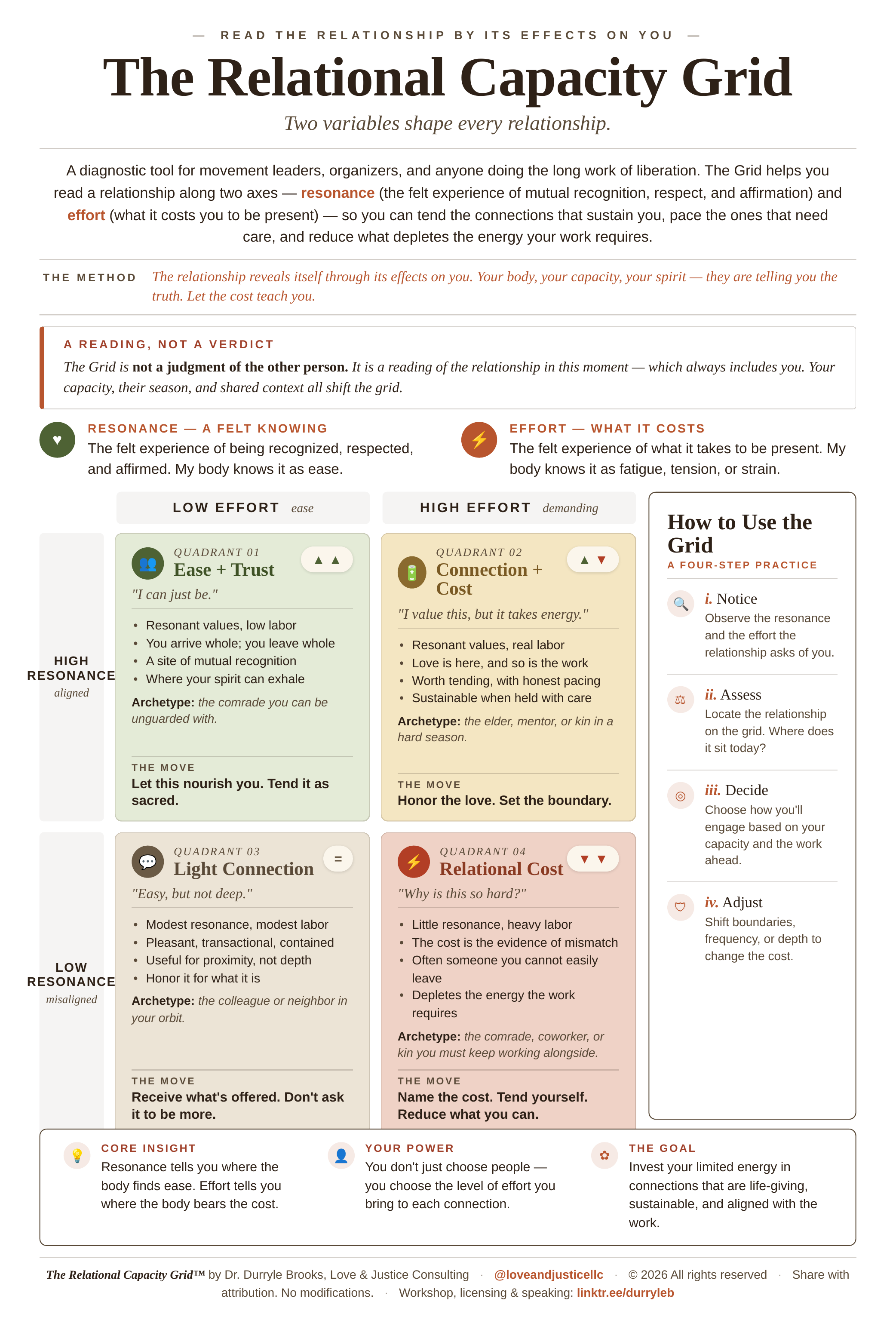
Available in two versions.Full-Color Version (PDF) — for screen viewing and sharing
Print-Friendly Version (PDF) — optimized for standard printers
-
The Relational Capacity Grid©- Workbook
The Relational Capacity Grid is a 114-page discernment workbook that teaches you to read a relationship by its effects on you, its resonance, and its cost. Plot each relationship along the four honest quadrants of the Grid: Ease and Trust, Connection and Cost, Light Connection, and Relational Cost.
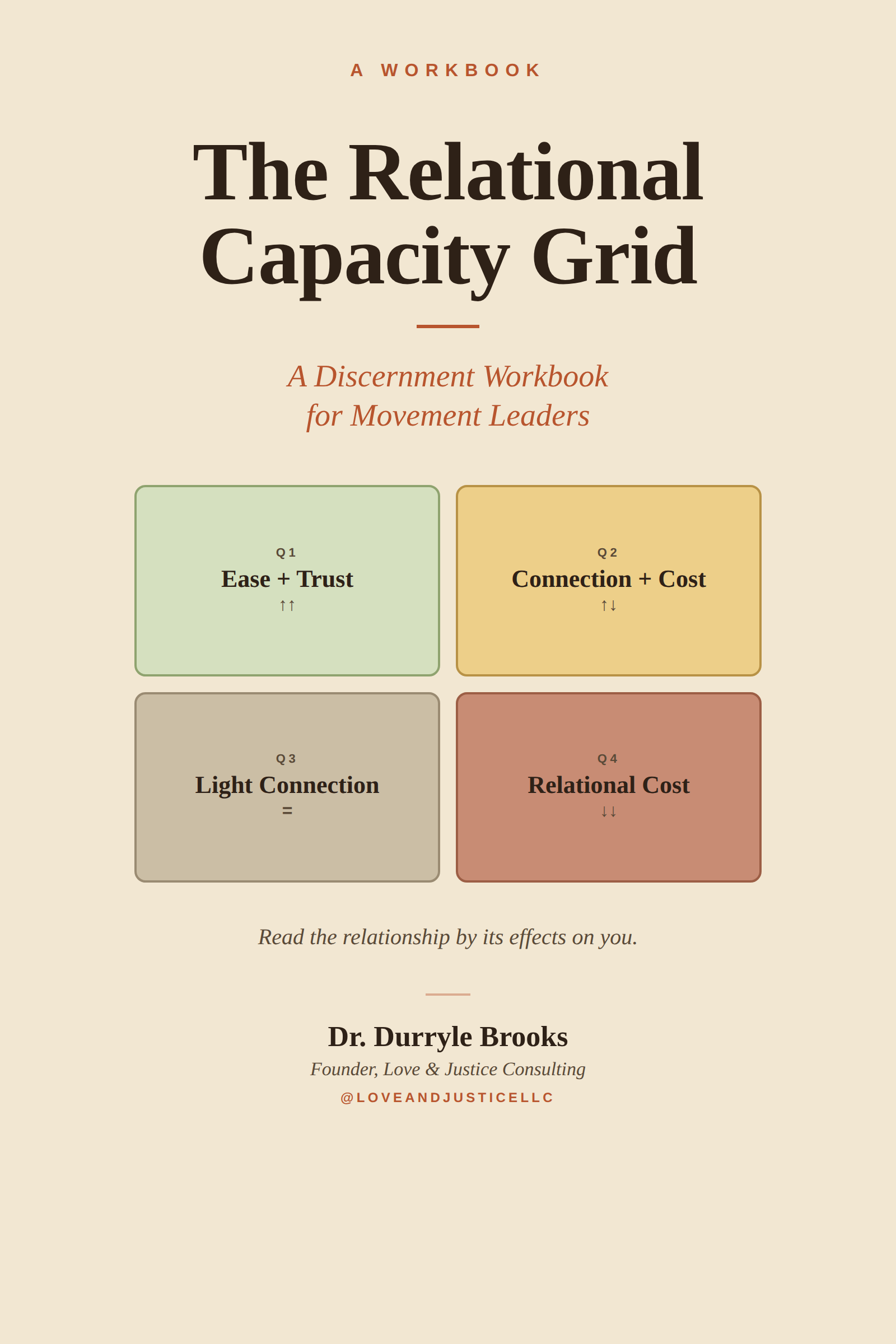
A framework for individuals, movement leaders, teams, and organizations.
For Individuals
If you have been taught that caring for others requires abandoning yourself, use the Grid© to read the relationships shaping your life, name what is costing you, and reclaim the right to protect your own capacity.
For Faculty, Student Affairs Professionals, and Higher Ed Leaders
If the institution rewards your over-functioning while quietly depleting you, use the Grid© to name what campus life is costing, identify resources for nourishment, and model establishing boundaries.
For Caregivers
If the people in your life expect you to pour endlessly without ever being poured into, use the Grid© to name the imbalance, honor what you actually have to give, and refuse the story that your worth depends on your capacity to give more than you have.
For Therapists, Coaches, and Somatic Practitioners
Use the Grid© to help clients name virtuous self-abandonment when they see it in themselves, and to open structured conversations about relational capacity, boundaries, and sustainability that feel diagnostic rather than shaming.
For Facilitators, Educators, and Group Leaders
Use the Grid© as a facilitation tool for cohorts, teams, and community spaces navigating burnout — a framework that lets participants name their patterns without shame and choose their engagement with intention
For Nonprofits, Organizations, and Movement Spaces
Use the Grid© to build a shared language for capacity across teams, coalitions, and community initiatives.
FAQs
-
The Relational Capacity Grid© is a diagnostic framework created by Dr. Durryle Brooks that helps you understand how the relationships in your life are affecting you. It helps you identify which relationships are healing and sustaining, which are draining or depleting, and where possibility may still exist. Each relationship is considered along two dimensions — resonance and effort — and mapped into one of four quadrants: Ease and Trust, Connection and Cost, Light Connection, and Relational Cost. The Grid supports intentional decision-making about where to invest, protect, restore, or redirect relational energy, and can be especially useful for understanding and responding to burnout. It is a tool for discernment, not judgment.
-
The Grid was created by Dr. Durryle Brooks, a scholar-practitioner and founder of Love and Justice Consulting. It is grounded in his peer-reviewed scholarship on the Critical Theory of Love© and has been refined through more than a decade of applied facilitation with movement leaders, educators, therapists, and organizations doing the long work of justice.
-
Use the Grid© to bring one relationship at a time into focus. Notice where it sits today, name what it is costing you and giving you, and choose your engagement with intention. Relationships move between quadrants over time, so the Grid© is meant to be returned to, not completed once. Many people use it monthly, seasonally, or during periods of transition.
-
Item descriptionBurnout is not only shaped by workload. Relationships can also require significant emotional, mental, and relational energy. Use the Relational Capacity Grid to notice which relationships leave you feeling depleted, obligated, guarded, or overextended, and which relationships help you feel supported, restored, grounded, or more like yourself. Then consider what changes might help protect your capacity — such as setting boundaries, asking for support, reducing exposure, repairing a relationship, or investing more intentionally in the relationships that sustain you.
-
Yes. Practitioners are welcome to reference the Grid© in one-on-one sessions with clients as a shared discernment tool, provided that Dr. Durryle Brooks is credited as the source and the framework is used in its complete and unaltered form. The Grid© pairs especially well with somatic and body-based practices because it invites clients to read their relationships through what their body already knows.
-
The Grid© may be referenced in educational and nonprofit settings with attribution to Dr. Durryle Brooks and Love and Justice Consulting. For paid workshops, professional trainings, curriculum development, or organizational programming built around the Grid©, please reach out to book a consultation. Trainings and workshops based on the Relational Capacity Grid© are currently offered exclusively through Love and Justice Consulting.
-
No. The Grid© may not be modified, adapted, or recreated in a different form. Its integrity depends on its structure — the two axes, the four named quadrants, and the language that grounds them. Please share it in its complete and unaltered form. If you have a use in mind that requires adaptation, please reach out and we can talk about licensing.
-
The free overview PDFs — both the full-color version and the print-friendly version — are available for download on this page. The full 114-page discernment workbook, which extends the framework into deeper personal and professional practice, is available on Gumroad. For workshops, keynotes, licensing, and organizational trainings, visit linktr.ee/durryleb.
-
Yes. Organizations, publishers, curriculum developers, and practitioners who would like to license the Relational Capacity Grid© for use beyond what is permitted in the standard sharing terms are invited to reach out. Licensing arrangements are available for uses such as inclusion in paid courses, professional certifications, adapted training programs, published materials, translations, and organization-wide implementations. To explore a licensing arrangement, please email durryleb@loveandjusticeconsulting.com.
-
The Grid© is one of several applied tools that grow out of Dr. Brooks's broader scholarship on the Critical Theory of Love© — a framework that reconceptualizes love as a political and pedagogical commitment to resist erasure and dehumanization. The Grid© puts that theory into practice at the level of individual relationships, giving people a way to discern where love is doing what love is meant to do, and where the cost of a relationship has become the evidence of a deeper mismatch.
-
The Grid helps you notice which relationships are sustaining you, which are draining you, where possibility still exists, and how much relational energy different relationships require. It can help you make more intentional decisions about where to invest, protect, restore, or redirect your capacity.